

An interesting part of game theory is the concept of forced wins in two-player games. This means that at one stage, a player can make a series of moves in the game that will surely result a win, regardless of what the other player has up his sleeve. There’s been a lot of study about this, for example, on the endgames in chess.
Here, we’re gonna play one game in particular, that we define ourselves.
Rook on the chessboard
A chessboard contains a lone rook, initially on the left-bottom corner square of the board. As you might know, a rook can only move in the horizontal or the vertical direction in a single move.
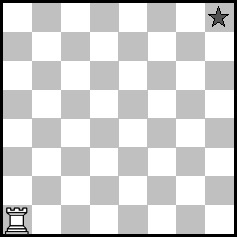
However, we’re going to add another restriction to the rook’s movement in this game:
The rook is allowed to move only towards the right, or upwards, in a single move. It is not allowed to move ‘back’ (i.e., left and/or down).
With this in mind, two players take turns in moving the rook. The player who moves the rook onto the square in the opposite corner, the one marked by the star, wins.
Note that a player cannot decide not to make a move; a move must be made every turn. So, it is clear that the game will end in a finite number of moves, and not go on forever.
- +Want a hint?
Is there a specific position of the rook from where a player will surely win?
- +The solution!
You might have already got the answer. The hint tells you to find a position from which one player would win. The key here is that once you find such a position, the aim of the game is now to get to that position, since you’re gonna win from there, anyway.
Which position is this? It’s the square diagonal to the starred square. Why?
Because: say the rook is at that position. Now, the next player (whichever that is) moves. The only possible moves are up or right. And obviously, the other player can move the rook accordingly onto the corner square and win.
To get to the starred square, we need to get to the one diagonal to it. How do we do that? Wait… what about analysing it the same way again? The square diagonal to the one we just found?
Well, it’s slightly different this time, since the next player can move the rook either one or two squares in a direction, but if he moves two squares, the other player wins anyway. So yes, our logic still holds. We need to get to the square diagonal to the square diagonal to the starred square.
You must be getting the hang of it by now. Can you conclude something simple from this?
To sum it up: if you can move the rook onto the diagonal when it’s your move, you win. Why?
Because: the other player must move it out of the diagonal, and you’ll always move it back. So eventually, you will be the winner.
And since the first player to play always has to move the rook out of the diagonal, the second player can always win the game.
So that’s a very simple example of a forced win in a two-player game. Games like chess are, of course, much more complicated. Which is why people still play chess. I mean, do you really think there would be international “Rook Game” competitions?
For the next in this series, go to Y(S)L – 2.